Trying to have witty repartee with AI can feel like doing card tricks for a dog. I was delighted Copilot got the joke when I followed up a question about converting kph to mph with a question about furlongs per fortnight.

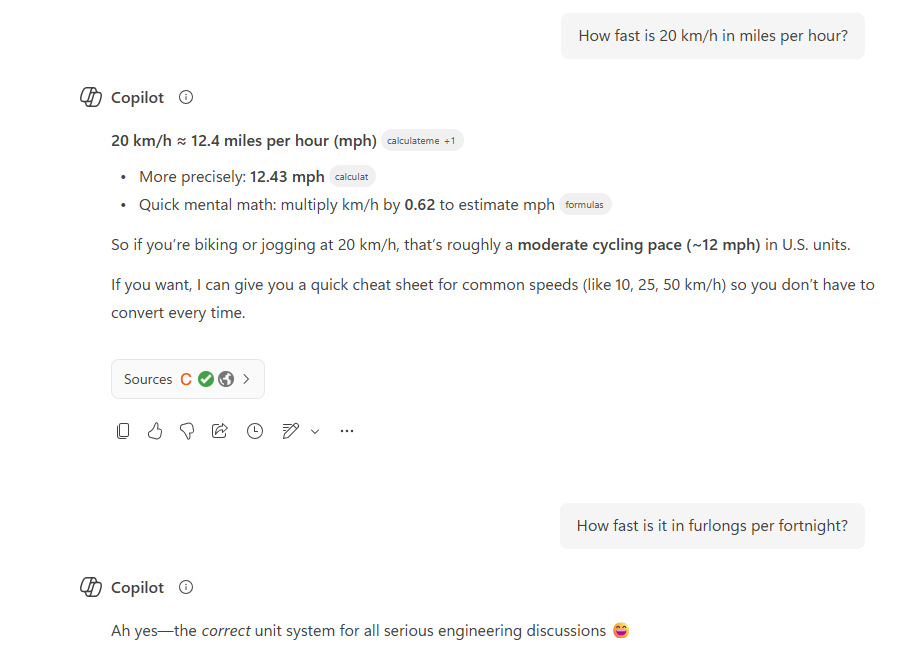
Trying to have witty repartee with AI can feel like doing card tricks for a dog. I was delighted Copilot got the joke when I followed up a question about converting kph to mph with a question about furlongs per fortnight.

I’ll talk about Shakespeare with anyone willing to join me. The first time I tried Chat GPT, looking at the blank box on the screen with the intention of taking the thing for spin but not actually having anything in mind to task it with, I think I must have wanted to test whether it had any sense of irony. I threw some Shakespeare at it. “Should I ever a borrower or lender be?” And then it came back with a strong attempt to give me financial guidance for the 21st century. It didn’t reference Polonius passing on the advice to Hamlet. So my follow up was, “But isn’t Polonius an ass?” It came back with a strong “No” and more or less explained that his advice was wisdom that had been recognized for centuries. I moved on to other topics.
After about three and half years, I figured things had progressed enough that it was time to try again. And now I have more choices. I’m settling into a new personal computer and trying out AI tools, so I fired up Chat GPT, Claude, and Gemini. As before each tried to provide a framework of financial guidance for our contemporary world, but this time each did start out by referencing Polonious’ line. Responses to the follow up question, “But isn’t Polonious an ass?” did a good job explaining how the audience should read Polonious, and they mostly used the same language. Claude, was my favorite with it’s gleeful exclamation mark, “Yes, absolutely!” Gemini used boldface and hanging quotes “Most scholars and audiences would agree: yes, Polonius is absolutely an ‘ass.’” Chat GPT brought out all the punctuation and used italics “Short answer: yeah…he kind of is—but in a very intentional way.” I enjoyed Gemini describing the speech as “a collection of sententious platitudes” which sounds pretty damning. I also enjoyed Claude describing the “endless string of maxims” and Polonius “firing them off like fortune cookies.” Each had a good basic understanding of dramatic irony, and Claude even made a try at breaking the fourth wall: “the joke may be on everyone who quotes ‘Neither a borrower nor a lender be’ as genuine sage advice.”
Claude also put forward that Ian Holm had played Polonius when he was with the Royal Shakespeare company, but added “I’d also gently flag that I should have been more careful earlier — my claim about Ian Holm playing Polonius specifically was stated with more confidence than I can actually back up.” Some of the best arguments I’ve heard about how to interpret Shakespeare have been backed up with had nothing more than the inflection with which they were delivered, so I’m not going to hold Claude’s initial claim against it. I looked it up and now realize I need to watch the 1990 film where Mel Gibson played Hamlet and Ian Holm played Polonius. I bet Holm is fun. When he was with the RSC he did play two of the greatest asses in all of Shakespeare–Malvolio and Troilus. I’m sure I’ll get around to writing about both Twelfth Night and Troilus and Cressida sooner or later. And as the android in Alien, Holm was wonderfully ironic about being human.
To quickly give someone a look at the state of computer vision, there is a fun demo on the Google Cloud Vision site. You just drag a photo onto it, and you can learn what the AI sees along a few key vectors. After seeing it easily recognize and classify my photos of poodles and cherry trees, I started playing with photos I’ve taken that are actually tricky for humans to parse. Playing that type of game helps define the limits of what’s possible today, and things that happen at the boundaries suggest very interesting possibilities for tomorrow. I found that Cloud Vision today can touch on the subjective experiences of viewing art, and also do a good job sorting out things that are merely odd as opposed to things truly expressing artistic intent.
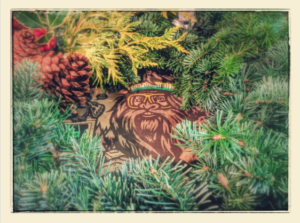
In this photo I laid a Christmas wreath on top of a pizza box that had an illustration of Sasquatch wearing a Seattle Sonics headband.

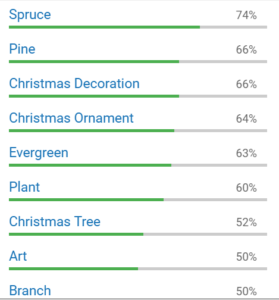
Cloud Vision nails the Christmas decoration aspect of the photo, but I was delighted to see that it indicated that there was about a 50% chance that this was some kind of art.

I’ll admit that it’s not very good art, but when I put together my little tableau, I was trying to capture something about the quirkiness of Seattle with an artifact I could use to communicate to people not from here. Personally, I’d set the odds of it being granted the status of “art” at much less than 50% so I felt Cloud Vision’s assessment was generous.
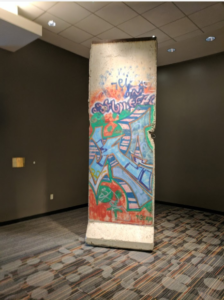
After that discovery through experimentation, I figured I should establish a control before doing more tests. Below is a photo from the Microsoft art collection. It’s a graffiti covered piece of the Berlin Wall on display at the Microsoft Conference Center in Redmond.

It’s been about 40 years since anyone has questioned whether or not graffiti art is worthy of gallery status—a sensibility Cloud Vision is certainly aware of based on how it labeled this piece.

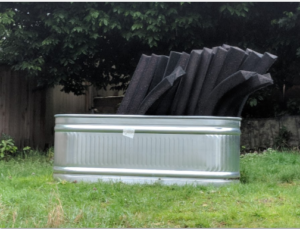
Below is a photo I took just because I was thinking, “I sure have some odd stuff in my yard.” The metal thing is a watering trough for livestock that is destined to be a planter. The black things sticking up out of it are foam gutter inserts that keep leaves from blocking your gutters but let water flow through.

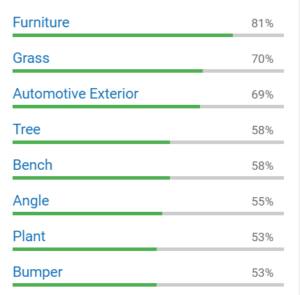
As a thing, it could be a Philistine’s parody of modern art (it bears a slight resemblance to Typewriter Eraser, Scale X by Claes Oldenburg) but not even the rubes would mistake it for actual art. Although I was a little surprised Cloud Vision couldn’t identify a watering trough, it did offer some pretty valid labels.

Mostly, I was heartened that it didn’t try to slap the label “art” on it.