
Derby pond


When I get around to forming my heavy metal band, the first album will be titled “Alms for Oblivion,” from Ulysses’ speech manipulating Achilles in Shakespeare’s Troilus and Cressida. I love how the phrase combines the sublime and the disposable in just three words. You can almost hear the riffage. Music is the art of time.
When my mood is turning sour, and I feel the need for aesthetic experience, I’m yearning for harmony and rhythm, not just mere beauty. My favorite photography communicates the experience of time. One of my favorite reasons for “going to the office” these days is Microsoft’s art collection. A couple days ago I was killing time before a meeting and discovered the work of Martin Klimas through his photograph of what happens when you cover a speaker in paint and blast Bach.
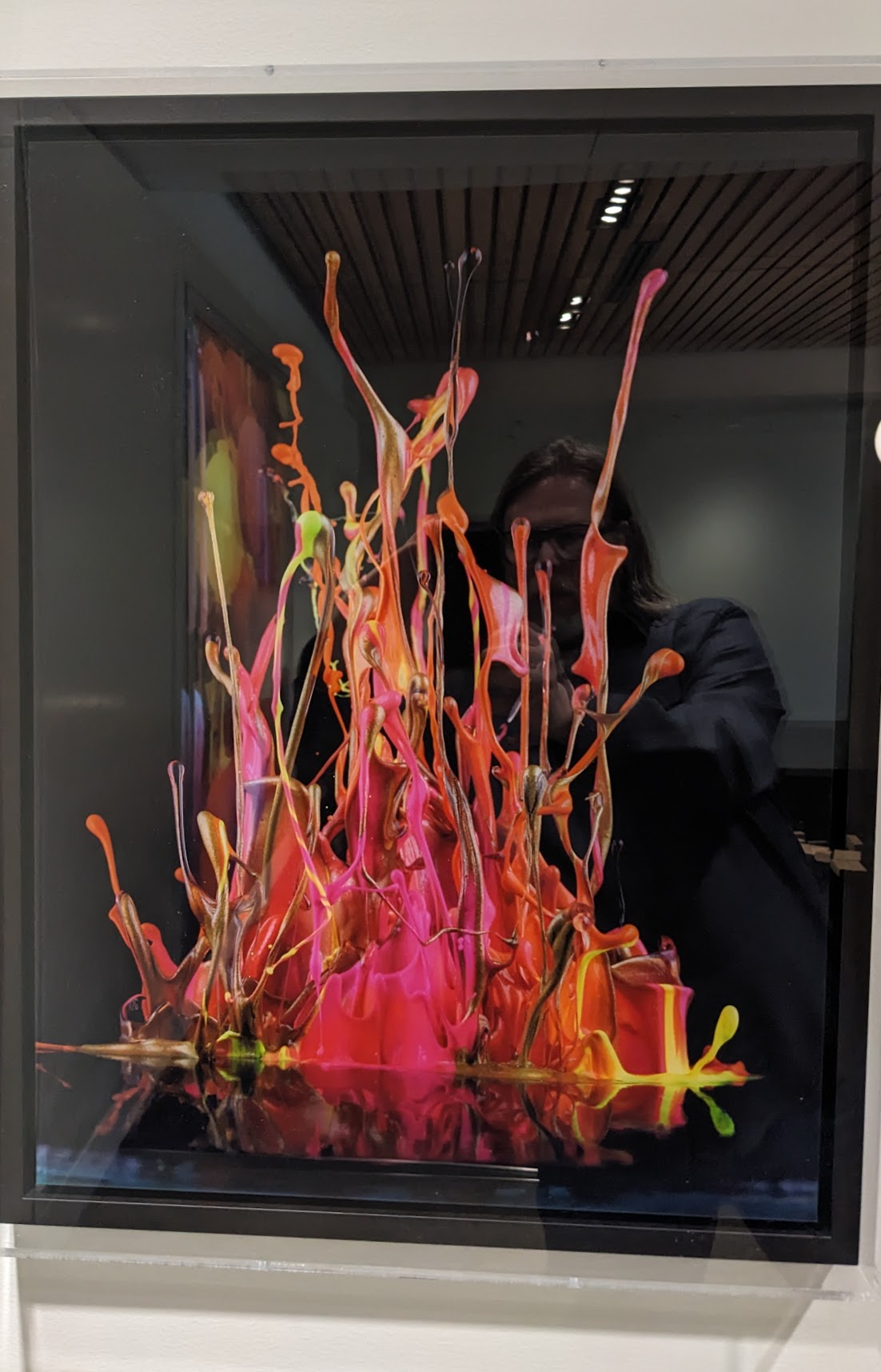
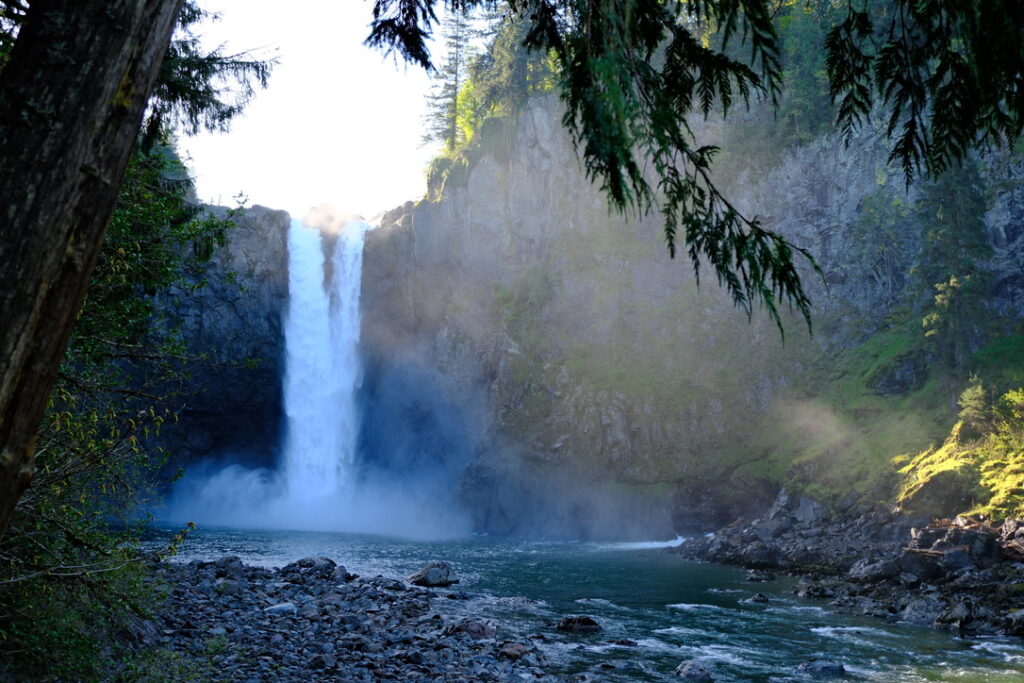
I’m guessing the shutter speed was 1/250 or faster. My photo of Snoqualmie Falls on my earlier post is 1/100 or 10 milliseconds. That’s around the threshold of human perception but significant in real-time audio, gaming, networking and API response times.
Sam Schillace has a great post about the mismatch between AI attention and human attention.
… This mismatch makes it easy for the AI to overwhelm you – – it never gets tired and there is always “more” of it. But there is something deeper going on that I didn’t fully capture, and it has to do with a strange fact about what LLMs actually are: LLMs don’t experience time.
I don’t mean that metaphorically, I mean it literally. When the model isn’t predicting tokens, it is perfectly quiescent in a way that has no human analog. There’s no waiting, no impatience, no sense that time is passing. It just stops existing, entirely, until the next token prediction is asked for. Between my prompts and its responses, nothing “happens” for the model — not because it’s fast, but because there is no experience of the interval at all.
Those tokens are alms for oblivion, indeed.
To quickly give someone a look at the state of computer vision, there is a fun demo on the Google Cloud Vision site. You just drag a photo onto it, and you can learn what the AI sees along a few key vectors. After seeing it easily recognize and classify my photos of poodles and cherry trees, I started playing with photos I’ve taken that are actually tricky for humans to parse. Playing that type of game helps define the limits of what’s possible today, and things that happen at the boundaries suggest very interesting possibilities for tomorrow. I found that Cloud Vision today can touch on the subjective experiences of viewing art, and also do a good job sorting out things that are merely odd as opposed to things truly expressing artistic intent.
In this photo I laid a Christmas wreath on top of a pizza box that had an illustration of Sasquatch wearing a Seattle Sonics headband.
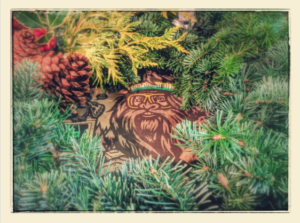
Cloud Vision nails the Christmas decoration aspect of the photo, but I was delighted to see that it indicated that there was about a 50% chance that this was some kind of art.
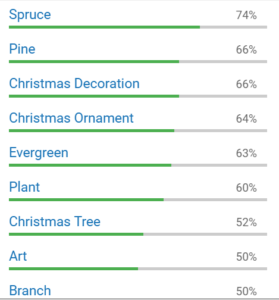
I’ll admit that it’s not very good art, but when I put together my little tableau, I was trying to capture something about the quirkiness of Seattle with an artifact I could use to communicate to people not from here. Personally, I’d set the odds of it being granted the status of “art” at much less than 50% so I felt Cloud Vision’s assessment was generous.
After that discovery through experimentation, I figured I should establish a control before doing more tests. Below is a photo from the Microsoft art collection. It’s a graffiti covered piece of the Berlin Wall on display at the Microsoft Conference Center in Redmond.
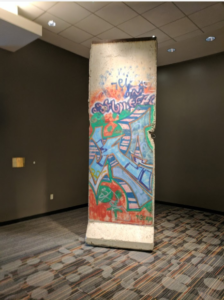
It’s been about 40 years since anyone has questioned whether or not graffiti art is worthy of gallery status—a sensibility Cloud Vision is certainly aware of based on how it labeled this piece.

Below is a photo I took just because I was thinking, “I sure have some odd stuff in my yard.” The metal thing is a watering trough for livestock that is destined to be a planter. The black things sticking up out of it are foam gutter inserts that keep leaves from blocking your gutters but let water flow through.
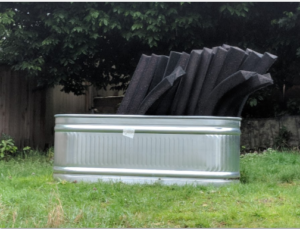
As a thing, it could be a Philistine’s parody of modern art (it bears a slight resemblance to Typewriter Eraser, Scale X by Claes Oldenburg) but not even the rubes would mistake it for actual art. Although I was a little surprised Cloud Vision couldn’t identify a watering trough, it did offer some pretty valid labels.
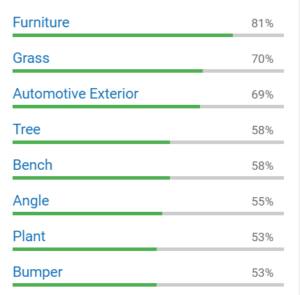
Mostly, I was heartened that it didn’t try to slap the label “art” on it.